Mortgage Rates September 19, 2024

Mortgage Rates Drop to Lowest Level in over a Year and a Half

Mortgage Rates Drop to Lowest Level in over a Year and a Half

Mortgage rates have hit their lowest point in over a year and a half. And that’s big news if you’ve been sitting on the homebuying sidelines waiting for this moment.

Even a small decline in rates could help you get a better monthly payment than you would expect on your next home. And the drop that’s happened recently isn’t small. As Sam Khater, Chief Economist at Freddie Macsays:

“Mortgage rates have fallen more than half a percent . . . and are at their lowest level since February 2023.”

But if you want to see it to really believe it, here’s how the math shakes out. Take a closer look at the impact on your monthly payment.

The chart below shows what a monthly payment (principal and interest) would look like on a $400K home loan if you purchased a house back in April (this year’s mortgage rate high), versus what it could look like if you buy a home now (see below):

No Caption ReceivedGoing from 7.5% just a few months ago to the low 6s has a big impact on your bottom line. In just a few months’ time, the anticipated monthly payment on a $400K loan has come down by over $370. That’s hundreds of dollars less per month.

Bottom Line

With the recent drop in mortgage rates, the purchasing power you have right now is better than it’s been in almost two years. Let’s talk about your options and how you can make the most of this moment you’ve been waiting for.

Mortgage Rates September 19, 2024

Falling Mortgage Rates Are Bringing Buyers Back Sept 2024

Falling Mortgage Rates Are Bringing Buyers Back

If you’ve been hesitant to list your house because you’re worried no one’s buying, here’s your sign it may be time to talk with an agent.

After months of high rates keeping buyers on the sidelines, things are starting to shift. Rates are already coming down due to a number of economic factors. And yesterday the Federal Reserve cut the Federal Funds Rate for the first time since they began raising that rate in March 2022. And while they don’t control mortgage rates, this sets the stage for mortgage rates to fall even further than they already have – especially since more cuts from the Fed are expected into next year. And lower mortgage rates are bringing more buyers back into the market. Lisa Sturtevant, Chief Economist at Bright MLS, says:

“A drop in the cost of borrowing will help fuel more homebuyer demand . . . Falling rates will also bring more sellers into the market.”

The best part? You can take advantage of that renewed buyer interest.

As Rates Fall, Buyer Activity Goes Up

The graph below illustrates the relationship between falling mortgage rates and rising buyer activity. The orange line represents the average 30-year fixed mortgage rate, while the blue line shows the Mortgage Bankers Association (MBA) Mortgage Application Index, which tracks the number of mortgage applications.

As you can see, as mortgage rates (orange) come down, the Mortgage Application Index (blue) rises, showing more people start to re-engage in the process (see graph below):

What This Means for You

According to the National Association of Realtors (NAR), home sales increased in July, which was a welcome shift after four straight months of declines. If you’re a homeowner thinking about selling, this uptick in buyer activity works in your favor.

More buyers means more competition, which can lead to higher offers and shorter time on the market for your house. And, according to Edward Seiler, AVP of Housing Economics at the Mortgage Bankers Association (MBA), this trend is expected to continue:

“MBA is expecting that slower home-price appreciation, coupled with lower rates, will ease affordability constraints and lead to increased activity in the housing market.”

All in all, the market is becoming more accessible to a wider range of buyers, which could result in even more people looking to purchase a house like yours.

With more buyers entering the market, now’s the time to start getting your house ready to sell.

Bottom Line

The recent decline in mortgage rates is already driving more buyers into the market, and experts project this trend will continue. Let’s work together to take advantage of this increased buyer demand and get your house ready to sell.

My Monthly Market Summary September 6, 2024

Market Summary for the Beginning of September 2024

Market Summary for the Beginning of September
Here are the basics – the ARMLS numbers for September 1, 2024 compared with September 1, 2023 for all areas & types:
  • Active Listings : 18,430 versus 11,969 last year – up 54% – and up 5.5% from 17,474 last month
  • Under Contract Listings : 6,658 versus 7,111 last year – down 6.4% – and down 8.6% from 7,287 last month
  • Monthly Sales: 5,683 versus 6,267 last year – down 9.3% – and down 8.5% from 6,208 last month
  • Monthly Average Sales Price per Sq. Ft.: $290.60 versus $282.14 last year – up 3.0% – and up 1.3% from $286.74 last month
  • Monthly Median Sales Price: $440,000 versus $435,000 last year – up 1.1% – but unchanged from $440,000 last month
The re-sale market continues in the doldrums and has reacted very little so far to the lower mortgage rates that have emerged since July. Under contract listings went down a further 8.6% during August rather than staging a recovery. Demand appears to be stronger in the new home sector but that has a relatively modest effect on the MLS statistics because the bulk of new homes are not listed on the MLS. However, one look at the stock price charts for the major homebuilders will tell you they are in a good mood.
Re-sale supply usually rises between August and November, but this year the trend got off to an early start and we have 5.5% more listings active and without a contract than a month ago. With demand weak and supply rising, sellers are not getting the break they were probably hoping for. Concession to buyers and price cuts continue to be common and widespread.
The contract ratio is somewhat less stable, and this represents a further cooling in the market. It seems many potential buyers want to see rates drop below 6% before they make a move.
The only bright spot for sellers is that pricing improved during August with the average $/SF rising 1.3% from July. However, the median sales price was unchanged and is up only 1.1% from a year ago. This is less than inflation so in real terms homes are cheaper than this time last year. This statement does not apply to the very top end of the market which has significantly risen in price over the last 12 months. In fact, we saw a new record of almost $32.4 million paid for a new home just completed in Paradise Valley’s Mummy Mountain Estates. Unusually, this was a spec home and it sold for more than $2,000 per sq. ft. The market over $5 million is not seeing the same conditions as the regular market.
It would take a resurgence in demand to pump more life back into this dormant regular market and so far it seems that the Federal Reserve has not done enough by suggesting they are in favor of dropping the base rate. The question now is whether actually dropping the rate in September is going to be an event or a snooze for home buyers.
As usual, we will have to wait and see. Look to the under contract count to be the first thing to show any pick-up in demand.  Source Cromford Report
Did you know that the housing affordability index has declined over the past four years; the Housing Affordability Index, which measures whether a typical family earns enough income to qualify for a mortgage on a median-priced home, has dropped to its lowest levels since 1996. This indicates that housing has become less affordable for the average American household.
The average American needs to spend an additional $11,434 annually to maintain the same standard of living they had in January 2021.  This increase is primarily due to higher costs in essential categories like food, transportation, housing, and energy.  Unfortunately, wages haven’t kept up with inflation.  All this impacts affordability for homes that have increased so much. The good news is that if the unemployment rate stays under 4.4% (Arizona is at $3.4%) and mortgage interest rates drop below 6%, it will maintain a robust housing market and economy.  We must get through this slow time of the year and the election; things will pick up again.
There is pent-up demand for housing if mortgage interest rates are below 6%.
VA loan programs allow 0 down out of pocket. Conventional loans require as little as 3% down, and FHA loans require 3.5% down. With a reasonable offer, the seller may pay most or all of the buyer’s closing costs. There are also down payment assistance programs.
Please visit my website for up-to-date information, daily blog, monthly reports, and seller and buyer guides, and sign up for Neighborhood News, “the best way to stay connected to what’s happening in the real estate market in your area.”  See homes that are for sale and recently sold, find out if home sales in your neighborhood are trending up or down, and see what homes around you are currently selling for.  Also, you can search real-time listings in any market area under SEARCH FOR HOMES.  Call or text me anytime.
The best compliment is a referral to your family and friends!  Thank you so much!
All the best,
SHAWN KEANE
REALTOR, ARIZONA
(602) 989-3209 Cell
Markets August 30, 2024

Hello from Shawn; where will things be in a year

Hello from Shawn; where will things be in a year

I would love to hear your thoughts…..
You can click below to see what others say about how the 2025 housing market may look like.
My thoughts and some statistical facts: As long as the economy can maintain jobs and interest rates continue their downward projection, the housing market should continue to support these levels and likely move up in 2025.
However, a lot can change in the coming months; the consumer is looking financially stressed, and there are signs everywhere that they are pulling back on spending.  Overall, delinquency rates for credit cards and auto loans have increased; in 2024, auto loan balances were 90 or more days delinquent, the highest rate since early 2021.  The delinquency rate on credit card loans has almost doubled compared to early 2021, and credit card loan balances have increased by nearly 30% since early 2021, an all-time high (many Americans are using their credit cards for essential living expenses).  Then you have the housing affordability index, which has declined over the past four years; the Housing Affordability Index, which measures whether a typical family earns enough income to qualify for a mortgage on a median-priced home, has dropped to its lowest levels since 1996.  This indicates that housing has become less affordable for the average American household.
I mention all this because it could profoundly affect the direction of the housing market in the next year or so.  Did you know that 28% of all home sales in Arizona this year were from cash buyers, leaving 72% that need a loan?
Please be on the lookout for my Phoenix area market report in the coming days. It will be detailed and specific to the Phoenix and surrounding housing market.  
2025 Housing Market Forecasts: What To Expect Nationally
Looking ahead to 2025, it’s important to know what experts are projecting for the housing market.
SHAWN KEANE
REALTOR, ARIZONA
(602) 989-3209 Cell
Markets August 30, 2024

2025 Housing Market Forecasts: What To Expect

2025 Housing Market Forecasts: What To Expect

Looking ahead to 2025, it’s important to know what experts are projecting for the housing market. And whether you’re thinking of buying or selling a home next year, having a clear picture of what they’re calling for can help you make the best possible decision for your homeownership plans.

Here’s an early look at the most recent projections on mortgage rates, home sales, and prices for 2025.

Mortgage Rates Are Projected To Come Down Slightly

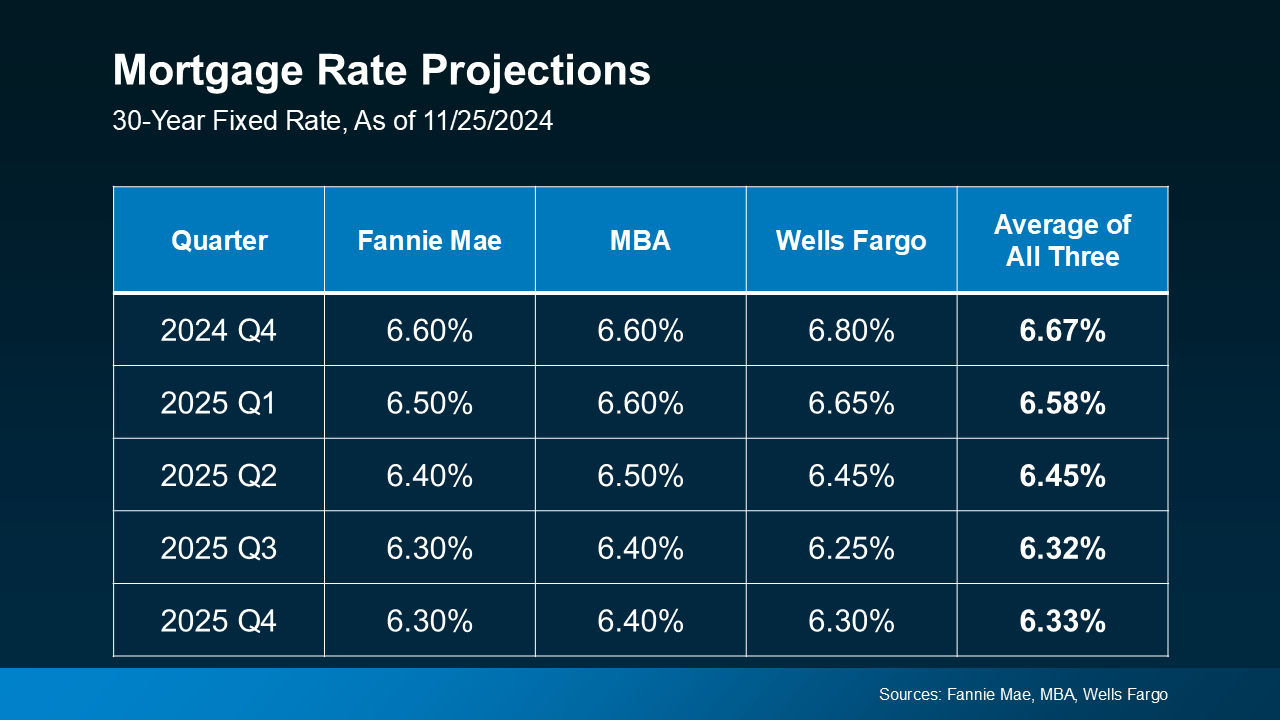
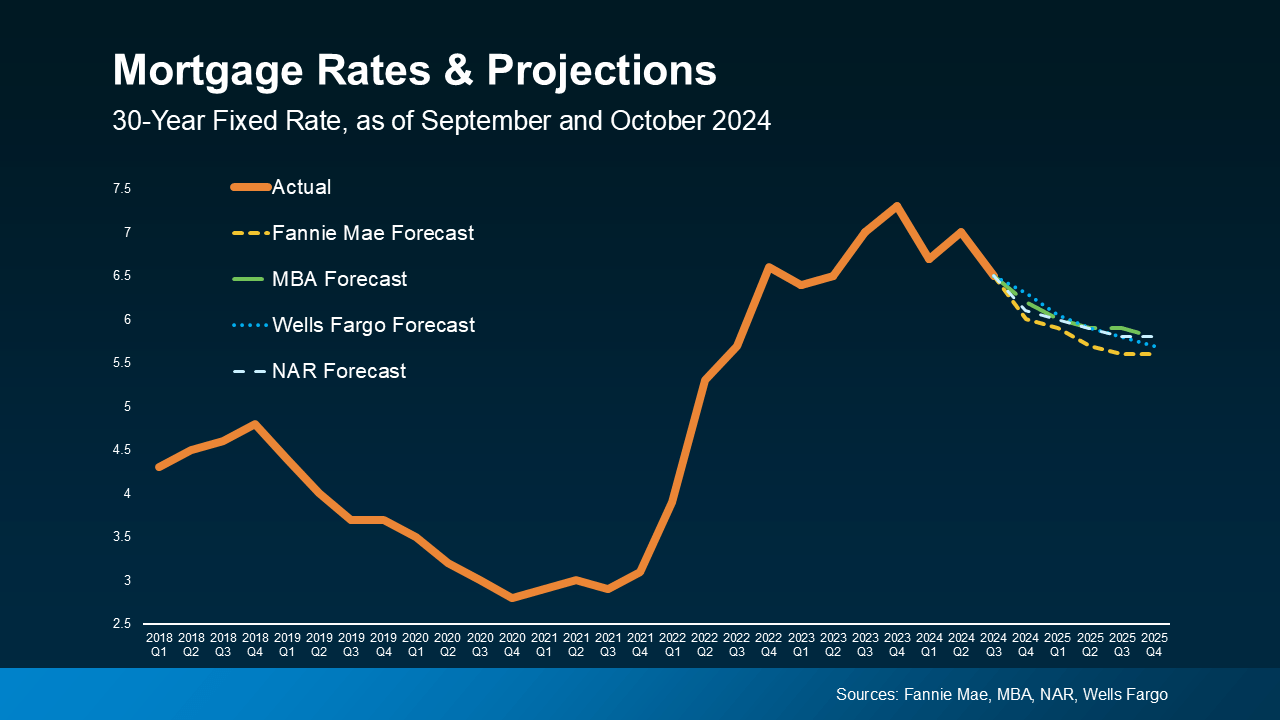
Mortgage rates play a significant role in the housing market. The forecasts for 2025 from Fannie Mae, the Mortgage Bankers Association (MBA), the National Association of Realtors (NAR), and Wells Fargo show an expected gradual decline in mortgage rates over the course of the next year (see chart below):

No Caption ReceivedMortgage rates are projected to come down because continued easing of inflation and a slight rise in unemployment rates are key signs of a strong but slowing economy. And many experts believe these signs will encourage the Federal Reserve to lower the Federal Funds Rate, which tends to lead to lower mortgage rates. As Morgan Stanley says:

“With the U.S. Federal Reserve widely expected to begin cutting its benchmark interest rate in 2024, mortgage rates could drop as well—at least slightly.”

Expect More Homes To Sell

The market will see an increase in both the supply of available homes on the market, as well as a rise in demand, as more buyers and sellers who have been sitting on the sidelines because of higher rates choose to make a move. That’s one big reason why experts are projecting an increase in home sales next year.

According to Fannie Mae, MBA, and NAR, total home sales are forecast to climb slightly, with an average of about 5.4 million homes expected to sell in 2025 (see graph below):

No Caption ReceivedThat would represent a modest uptick from the lower sales numbers in 2023 and 2024. For reference, about 4.8 million total homes were sold in 2023, and expectations are for around 4.5 million homes to sell this year.

While slightly lower mortgage rates are not expected to bring a flood of buyers and sellers back to the market, they certainly will get more people moving. That means more homes available for sale – and competition among buyers who want to purchase them.

Home Prices Will Go Up Moderately

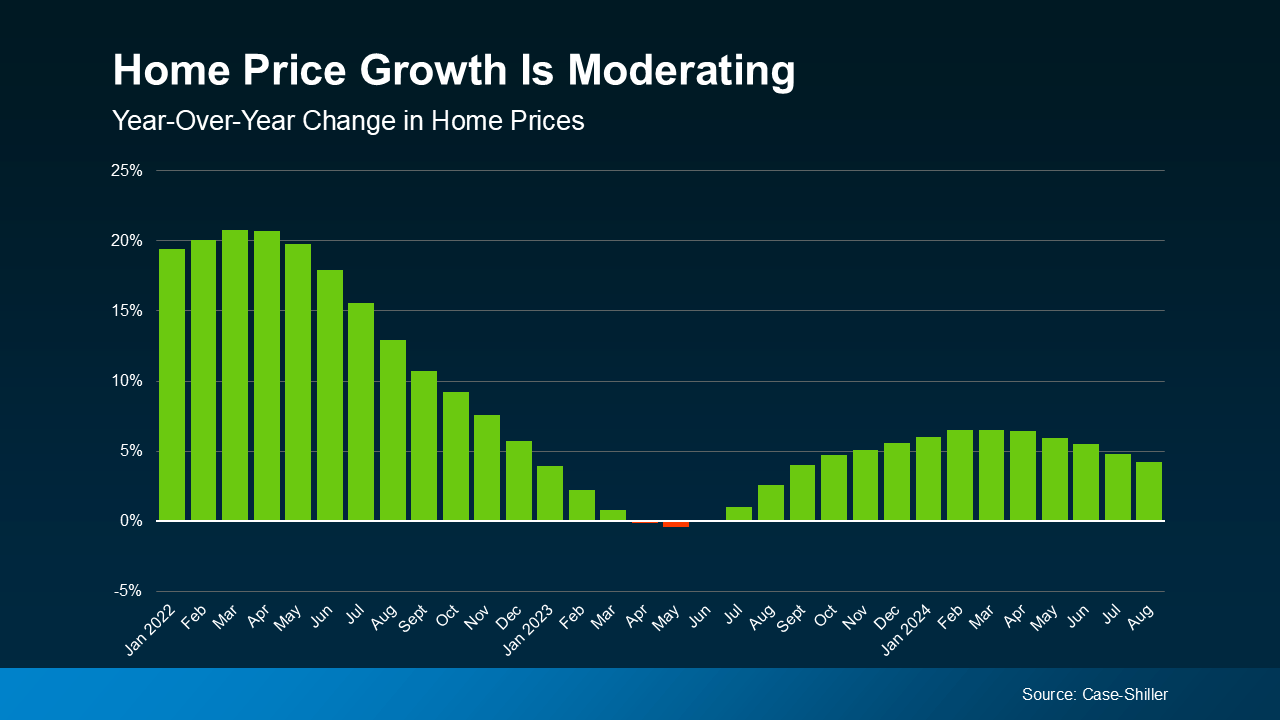
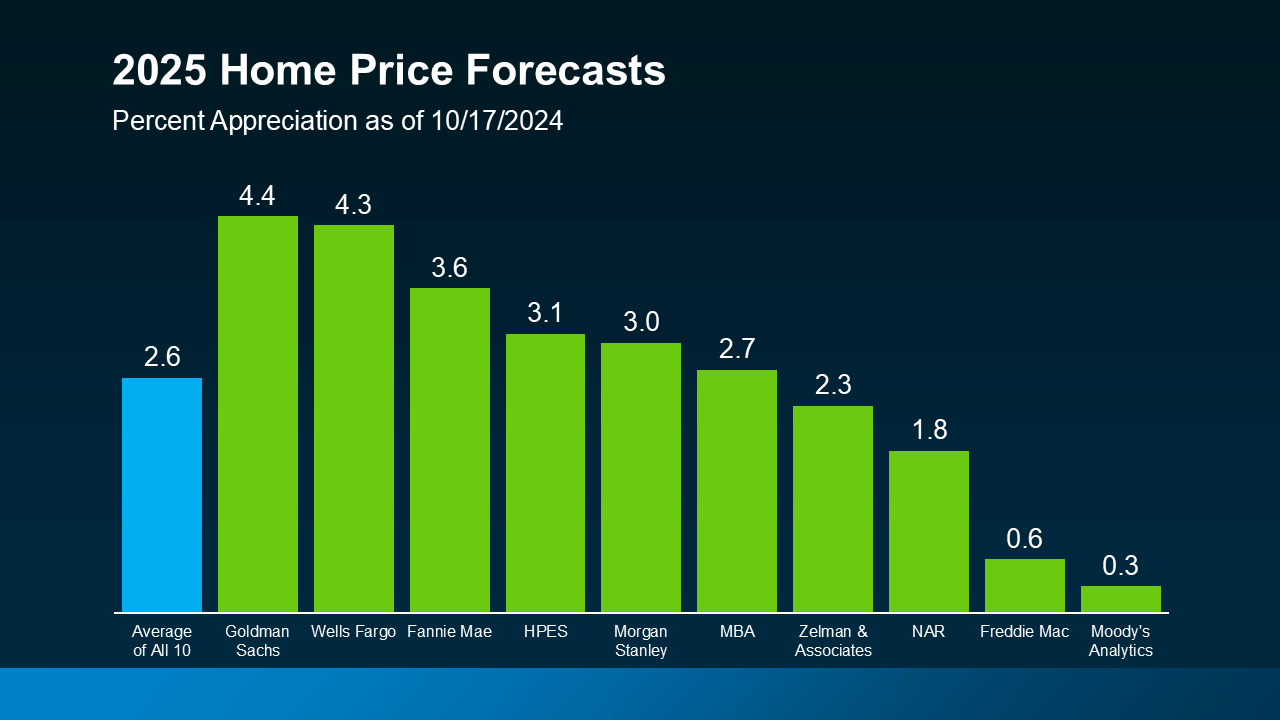
More buyers ready to jump into the market will put continued upward pressure on prices. Take a look at the latest price forecasts from 10 of the most trusted sources in real estate (see graph below):

No Caption ReceivedOn average, experts forecast home prices will rise nationally by about 2.6% next year. But as you can see, there’s a range of opinions on how much prices will climb. Experts agree, however, that home prices will continue to increase moderately next year at a slower, more normal rate. But keep in mind, prices will always vary by local market.

Bottom Line

Understanding 2025 housing market forecasts can help you plan your next move. Whether you’re buying or selling, staying informed about these trends will ensure you make the best decision possible. Let’s connect to discuss how these forecasts could impact your plans.

Markets August 30, 2024

Are We Heading into a Balanced Market?

Are We Heading into a Balanced Market?

If you’ve been keeping an eye on the housing market over the past couple of years, you know sellers have had the upper hand. But is that going to shift now that inventory is growing? Here’s a breakdown of what you need to know.

What Is a Balanced Market?

A balanced market is generally defined as a market with about a five-to-seven-month supply of homes available for sale. In this type of market, neither buyers nor sellers have a clear advantage. Prices tend to stabilize, and there’s a healthier number of homes to choose from. And after many years when sellers had all the leverage, a more balanced market would be a welcome sight for people looking to move. The question is – is that really where the market is headed?

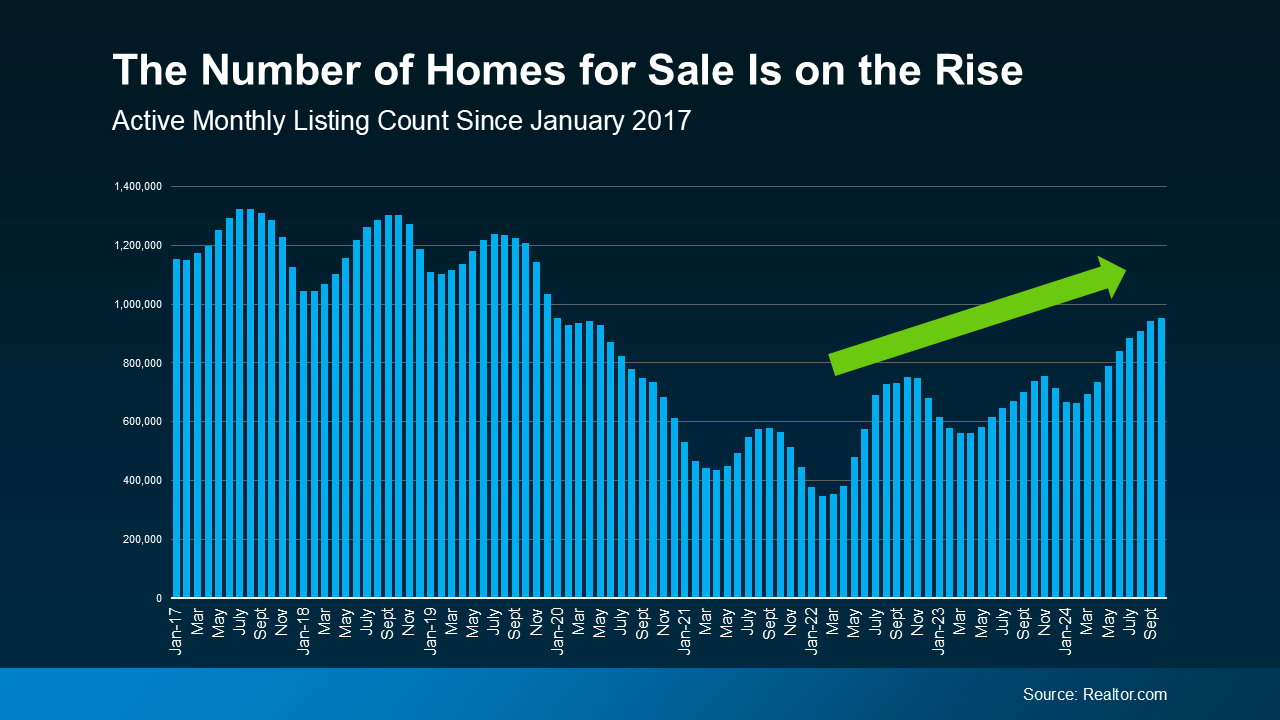
After starting the year with a three-month supply of homes nationally, inventory has increased to four months. That may not sound like a lot, but it means the market is getting closer to balanced – even though it’s not quite there yet. It’s important to note this increase in inventory is not leading to an oversupply that would cause a crash. Even with the growth lately, there’s still nowhere near enough supply for that to happen.

The graph below uses data from the National Association of Realtors (NAR) to give you an idea of where inventory has been in the past, and where it’s at today:

No Caption ReceivedFor now, this is still seller’s market territory – it’s just not as frenzied of a seller’s market as it’s been over the past few years. As Mark Fleming, Chief Economist at First Americansays:

“The faster housing supply increases, the more affordability improves and the strength of a seller’s market wanes.”

What This Means for You and Your Move

Here’s how this shift impacts you and the market conditions you’ll face when you move. Lawrence Yun, Chief Economist at NAR, explains:

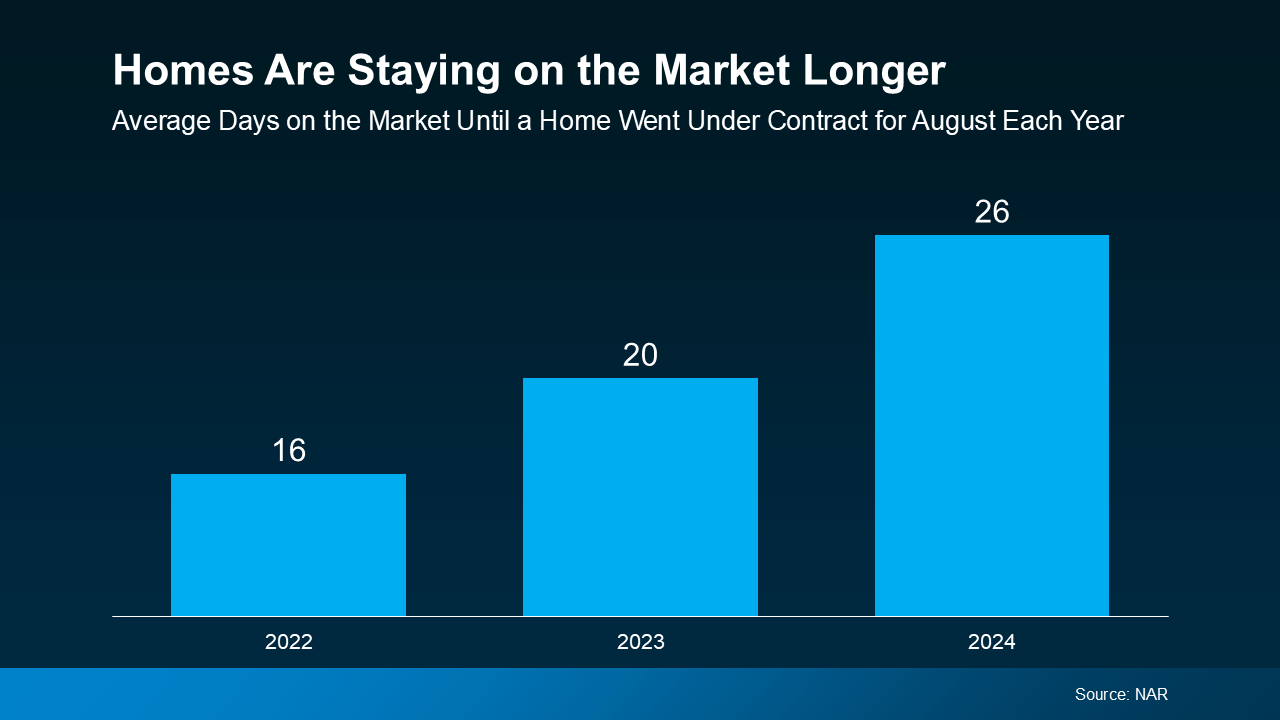
“Homes are sitting on the market a bit longer, and sellers are receiving fewer offers. More buyers are insisting on home inspections and appraisals, and inventory is definitively rising on a national basis.”

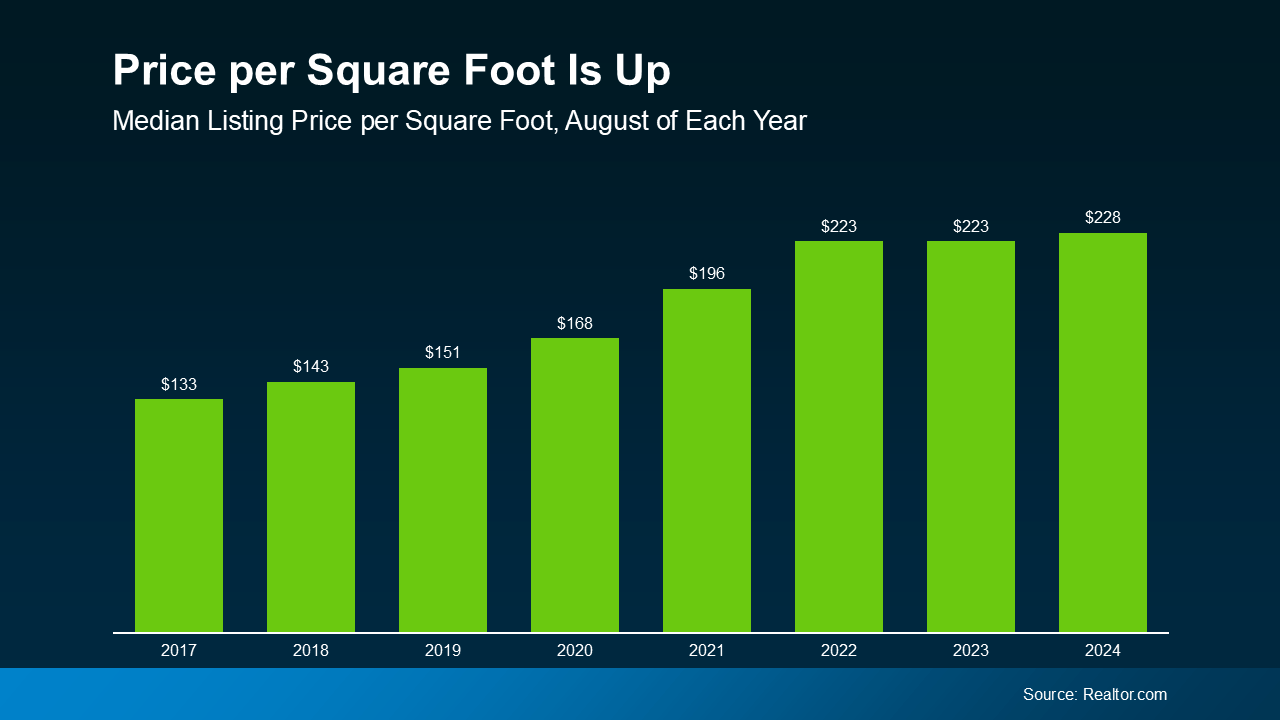
The graphs below use the latest data from NAR and Realtor.com to help show examples of these changes:

Homes Are Sitting on the Market Longer: Since more homes are on the market, they’re not selling quite as fast. For buyers, this means you may have more time to find the right home. For sellers, it’s important to price your house right if you want it to sell. If you don’t, buyers might choose better-priced options.

Sellers Are Receiving Fewer Offers: As a seller, you might need to be more flexible and willing to compromise on price or terms to close the deal. For buyers, you could start to face less intense competition since you have more options to choose from.

Fewer Buyers Are Waiving Inspections: As a buyer, you have more negotiation power now. And that’s why fewer buyers are waiving inspections. For sellers, this means you need to be ready to negotiate and address repair requests to keep the sale moving forward.

How a Real Estate Agent Can Help

But this is just the national picture. The type of market you’re in is going to vary a lot based on how much inventory is available. So, lean on a local real estate agent for insight into how your area stacks up.

Whether you’re buying or selling, understanding how the market is changing gives you a big advantage. Your agent has the latest data and local insights, so you know exactly what’s happening and how to navigate it.

Bottom Line

The real estate market is always changing, and it’s important to stay informed. Whether you’re buying or selling, understanding this shift toward a balanced market can help. If you have any questions or need expert advice, don’t hesitate to reach out.

Mortgage Rates August 9, 2024

How the Economy Impacts Mortgage Rates

How the Economy Impacts Mortgage Rates

As someone who’s thinking about buying or selling a home, you’re probably paying close attention to mortgage rates – and wondering what’s ahead.

One thing that can affect mortgage rates is the Federal Funds Rate, which influences how much it costs banks to borrow money from each other. While the Federal Reserve (the Fed) doesn’t directly control mortgage rates, they do control the Federal Funds Rate.

The relationship between the two is why people have been watching closely to see when the Fed might lower the Federal Funds Rate. Whenever they do, that’ll put downward pressure on mortgage rates. The Fed meets next week, and three of the most important metrics they’ll look at as they make their decision are:

  1. The Rate of Inflation
  2. How Many Jobs the Economy Is Adding
  3. The Unemployment Rate

Here’s the latest data on all three.

1. The Rate of Inflation

You’ve probably heard a lot about inflation over the past year or two – and you’ve likely felt it whenever you’ve gone to buy just about anything. That’s because high inflation means prices have been going up quickly.

The Fed has stated its goal is to get the rate of inflation back down to 2%. Right now, it’s still higher than that, but moving in the right direction (see graph below):

2. How Many Jobs the Economy Is Adding

The Fed is also watching how many new jobs are created each month. They want to see job growth slow down consistently before taking any action on the Federal Funds Rate. If fewer jobs are created, it means the economy is still strong but cooling a bit – which is their goal. That appears to be exactly what’s happening now. Inman says:

“. . . the Bureau of Labor Statistics reported that employers added fewer jobs in April and May than previously thought and that hiring by private companies was sluggish in June.”

So, while employers are still adding jobs, they’re not adding as many as before. That’s an indicator the economy is slowing down after being overheated for quite some time. This is an encouraging trend for the Fed to see.

3. The Unemployment Rate

The unemployment rate is the percentage of people who want to work but can’t find jobs. So, a low rate means a lot of Americans are employed. That’s a good thing for many people.

But it can also lead to higher inflation because more people working means more spending – which drives up prices. Right now, the unemployment rate is low, but it’s been rising slowly over the past few months (see graph below):

No Caption ReceivedIt may seem harsh, but a consistently rising unemployment rate is something the Fed needs to see before deciding to cut the Federal Funds Rate. That’s because a higher unemployment rate would mean reduced spending, and that would help get inflation back under control.

What Does This Mean Moving Forward?

While mortgage rates are going to continue to be volatile in the days and months ahead, these are signs the economy is headed in the direction the Fed wants to see. But even with that, it’s unlikely they’ll cut the Federal Funds Rate when they meet next week. Jerome Powell, Chair of the Federal Reserve, recently said:

“We want to be more confident that inflation is moving sustainably down toward 2% before we start the process of reducing or loosening policy.”

Basically, we’re seeing the first signs now, but they need more data and more time to feel confident that this is a consistent trend. Assuming that direction continues, according to the CME FedWatch Tool, experts say there’s a projected 96.1% chance the Fed will lower the Federal Funds Rate at their September meeting.

Remember, the Fed doesn’t directly set mortgage rates. It’s just that whenever they decide to cut the Federal Funds Rate, mortgage rates should respond.

Of course, the timing of when the Fed takes action could change because of new economic reports, world events, and other factors. That’s why it’s usually not a good idea to try to time the market.

Bottom Line

Recent economic data may signal that hope is on the horizon for mortgage rates. Let’s connect so you have an expert to keep you up to date on the latest trends and what they mean for you.

Mortgage Rates August 9, 2024

Mortgage Rates Down a Full Percent from Recent High 8-24

Mortgage Rates Down a Full Percent from Recent High

Mortgage rates have been one of the hottest topics in the housing market lately because of their impact on affordability. And if you’re someone who’s looking to make a move, you’ve probably been waiting eagerly for rates to come down for that very reason. Well, if the past few weeks are any indication, you may be getting your wish.

Mortgage Rates Trend Down in Recent Weeks

There’s big news for mortgage rates. After the latest reports on the economy, inflation, the unemployment rate, and the Federal Reserve’s recent comments, mortgage rates started dropping a bit. And according to Freddie Mac, they’re now at a level we haven’t seen since February. To help show the downward trend, check out the graph below:

No Caption ReceivedMaybe you’re seeing this and wondering if you should ride the wave and see how low they’ll go. If that’s the case, here’s some important perspective. Remember, the record-low rates from the pandemic are a thing of the past. If you’re holding out hope to see a 3% mortgage rate again, you’re waiting for something experts agree won’t happen. As Greg McBride, Chief Financial Analyst at Bankratesays: 

“The hopes for lower interest rates need the reality check that ‘lower’ doesn’t mean we’re going back to 3% mortgage rates. . . the best we may be able to hope for over the next year is 5.5 to 6%.”

And with the decrease in recent weeks, you’ve got a big opportunity in front of you right now. It may be enough for you to want to jump back in.

The Relationship Between Rates and Demand 

If you wait for mortgage rates to drop further, you might find yourself dealing with more competition as other buyers re-ignite their home searches too.

In the housing market, there’s generally a relationship between mortgage rates and buyer demand. Typically, the higher rates are, the lower buyer demand is. But when rates start to come down, things change. Buyers who were on the fence over higher rates will resume their searches. Here’s what that means for you. As a recent article from Bankrate says:

If you’re ready to buy, now might be the time to strike. Home prices have been rising primarily because of a longstanding shortage of homes for sale. That’s unlikely to change, and if mortgage rates do fall below 6%, it’s possible buyers would enter the market en masse, further pushing up prices and resurrecting bidding wars.”

Bottom Line

If you’ve been waiting to make your move, the recent downward trend in mortgage rates may be enough to get you off the sidelines. Rates have hit their lowest point in months, and that gives you the opportunity to jump back in before all the other buyers do too.

If you’re ready and able to start the process, reach out and let’s get started.

My Monthly Market Summary August 6, 2024

Market Summary for the Beginning of August 2024

Market Summary for the Beginning of August

Good evening,

Overall, the Greater Phoenix housing market is neutral; however, more areas are slightly favoring buyers. With mortgage rates heading down to the 6% area this should fuel demand therefore decrease inventory as we saw last month, neutral scenario may flip again, we shall see.  If you’re considering selling or buying, please give me a call to discuss your situation and what’s important to you.

Here are the basics – the ARMLS numbers for August 1, 2024 compared with August 1, 2023 for all areas & types:

  • Active Listings: 17,677 versus 11,241 last year – up 55% – but down 3.6% from 18,121 last month
  • Under Contract Listings: 7,287 versus 7,546 last year – down 3.4% – and down 1.6% from 7,402 last month
  • Monthly Sales: 6,199 versus 5,915 last year – up 4.8% – but down 2.0% from 6,324 last month
  • Monthly Average Sales Price per Sq. Ft.: $286.58 versus $281.97 last year – up 1.6% – but down 2.9% from $295.15 last month
  • Monthly Median Sales Price: $440,000 versus $434,900 last year – up 1.2% – but down 2.2% from $450,000 last month

There is very little positive about these numbers as the Greater Phoenix housing market continues to suffer from weak demand and low volumes. However, if you dig deeply, you can find some excuses for mild optimism. The supply has fallen over the past month and although it remains significantly higher than last year, it is now on a downward trend, at least for the short term. We also see a very slight up-tick in pending listings from last month, though this positive sign is counterbalanced by a decline in listings under contract.

At first the monthly sales count looks promising – up 4.8% from July 2023, but as there was 1 more working day in July 2024, this is largely an illusion. Closings remain far below normal levels and professions that get paid at closing continue to suffer from a shortage of revenue.

Though there are plenty of credit problems in other sectors (e.g. auto loans, credit cards), home loans are looking very healthy with delinquency stuck at low levels. This also means foreclosure volumes are very small and there is little sign of that changing in the near to medium term. You Tubers have been forecasting a new tsunami of foreclosures for over 5 years now and have managed to be 100% wrong. Those who would love to see more bank-owned homes enter the market are out of luck. There is also no sign of their luck changing in the near term.

Most pricing measures have fallen hard since May, but that is largely due to seasonal effects. This is particularly true of average active listing prices. This is because listings for luxury homes have been disappearing at great speed. Most were not sold. The majority were cancelled or expired. For example, the number of active listings over $2 million is down 22% over the past 2 months, while those over $7.5 million are down 42%.

Current pricing is only slightly ahead of this time last year, with the median sales price up only 1.2%. Most things have risen far more than 1.2% over the past 12 months, so homes are effectively cheaper in real terms than they were a year ago.

Mortgage rates have dropped hard over the last 3 days, with the average 30-year fixed rate down from 6.80% to 6.40%.. They could drop further if the Federal Reserve does as expected and lower the base rate at their September meeting. Nothing is certain, but it would be a fair guess that demand would pick up significantly if rates get back around the 6% mark.

Overall, the market is balanced with a slow and gentle trend towards greater bargaining power for buyers. However, now that supply is falling, it would only take a small increase in demand to reverse that trend.  Source Cromford Report

Please visit my website for up-to-date information, daily blog, monthly reports, seller and buyer guides and sign up for Neighborhood News “the best way to stay connected to what’s happening in the real estate market in your area”.  See homes that are for sale and recently sold, find out if home sales in your neighborhood are trending up or down, see what homes around you are currently selling for.  Also, you can search real time listings in any area of the market under SEARCH FOR HOMES.  Call or text me anytime 😊

The best compliment is a referral to your family and friends!  Thank you so much!

All the best,

Shawn Keane


Uncategorized August 5, 2024

The Biggest Mistakes Sellers Are Making Right Now 2024

The Biggest Mistakes Sellers Are Making Right Now

The housing market is going through a transition. Higher mortgage rates are causing more moderate buyer activity at the same time the supply of homes for sale is growing.

And if you aren’t working with an agent, you may not realize that. Here’s the downside. If you’re not informed, you can’t adjust your strategy or expectations to today’s market. And that can lead to a number of costly mistakes.

Here’s a look at some of the most common ones – and how an agent will help you avoid them when you sell.

1. Overpricing Your House

Many sellers set their asking price too high and that’s why there’s an uptick in homes with price reductions today. An unrealistic price will deter potential buyers, cause an appraisal issue, or lead to your house sitting on the market longer. An article from the National Association of Realtors (NAR) explains:

“Some sellers are pricing their homes higher than ever just because they can, but this may drive away serious buyers and result in unapproved appraisals . . .”

To avoid falling into this trap, partner with a pro. An agent uses recent sales of similar homes, the condition of your house, local market trends, and so much more to find the price that’ll attract more buyers and open the door for multiple offers and a faster sale.

2. Skipping the Small Stuff

You may try to skip important repairs, thinking you can pass the task on to your buyer. But visible issues (even if they’re small) can turn off potential buyers and result in lower offers or demands for concessions. As Money Talks News says:

“Home shoppers like to turn on lights, flush toilets and run the water. If these basic things don’t work, they may assume you’ve skipped other maintenance. Homes that appear neglected aren’t likely to fetch top price.”

If you want to get your house ready to sell, the best place to turn to for advice is your agent. They’ll be able to do a walk-through with you and point out anything you’ll need to tackle before the photographer comes in.

3. Not Looking at Things Objectively

Buyers today are feeling the pinch of high home prices and mortgage rates. With affordability that tight, they may come in with an offer that’s lower than you’d want to see – especially if you didn’t stage, price, or market the house well.

It’s important you don’t take this personally. Getting overly emotional can put the sale at risk. As an article from Ramsey Solutions says:

“Remember, a buyer’s offer is not a reflection of their opinion of your home or your housekeeping abilities. . . The sale of your home is strictly a business transaction. If they start out with a low offer, don’t take it personally and get emotional. Instead, channel that energy toward negotiating. Work with your agent and make a counteroffer.”

4. Being Unwilling To Negotiate

The supply of homes for sale has grown. That means buyers have more options, and with that comes more negotiation power. As a seller, you may see more buyers getting an inspection, requesting repairs, or asking for help with closing costs today. You need to be prepared to have those conversations. As U.S. News Real Estate explains:

“If you’ve received an offer for your house that isn’t quite what you’d hoped it would be, expect to negotiate . . . the only way to come to a successful deal is to make sure the buyer also feels like he or she benefits . . . consider offering to cover some of the buyer’s closing costs or agree to a credit for a minor repair the inspector found.”

An agent will walk you through what levers you may want to pull based on your own goals, budget, and timeframe.

5. Not Using a Real Estate Agent

Notice anything? For each of these mistakes, partnering with an agent helps prevent them from happening in the first place. That makes trying to sell your house without an agent’s help the biggest mistake of all.

Real estate agents have experience and expertise in pricing, marketing, negotiating, and more. That knowledge streamlines the selling process and usually results in drumming up more interest and ultimately can get you a higher final price.

Bottom Line

If you want to avoid making mistakes like these, let’s connect to make sure you’re set up for success.